



NEWS&EVENTS
Home > News&Events > Company news > The role of electrowinning cell in hydrometallurgical tin smelting
In the industrial process of wet tin smelting, the electrolytic cell, as the core equipment, undertakes the key task of converting tin ions in the solution into metallic tin. Its efficiency and stability directly determine the recovery rate, purity and production cost of tin products. It is an important support for modern tin smelting technology to move towards high efficiency and greenness.
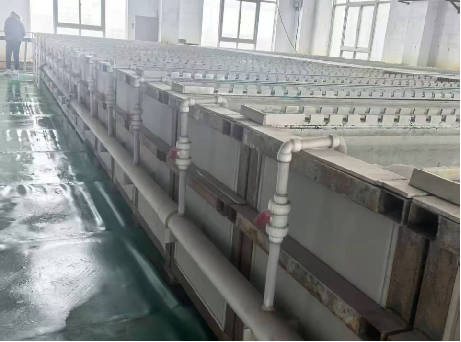
The hydrometallurgical tin smelting process, centered around the electrowinning cell, forms a closed-loop system of "leaching-purification-electrowinning." First, the tin ore is converted into a tin-containing solution (such as SnCl?/SnCl?) through acid leaching or chlorination, transferring the tin element from solid mineral to liquid ions. The solution then undergoes purification processes such as solvent extraction, ion exchange, or chemical precipitation to remove impurities such as iron, copper, and lead, ensuring the high purity of the electrolyte. Finally, the purified solution enters the electrowinning cell. Under the influence of direct current, the tin ions at the cathode (pure tin plate or stainless steel plate) receive electrons and are reduced to metallic tin. At the anode (Pb-Ag alloy), a water decomposition reaction occurs to generate oxygen, completing the directional deposition of tin.
The design and operating parameters of the electrowinning cell are crucial to process effectiveness. The cell structure must balance solution circulation uniformity and current distribution stability. The choice of electrode material directly impacts deposition efficiency and energy consumption—the cathode material must ensure a dense tin layer, while the anode must balance conductivity and corrosion resistance. Furthermore, precise control of parameters such as electrolyte temperature, current density, and additive ratios can further optimize tin crystallization, reduce impurity carryover, and increase product purity to over 99.9%.
As the "heart" of hydrometallurgical tin smelting, the technological breakthrough of the electrolytic cell has not only pushed the tin recovery rate to more than 95%, but also helped the traditional smelting industry to transform into a green and low-carbon one through its advantages of low energy consumption and low emissions, becoming a model of modern non-ferrous metal extraction technology.