



NEWS&EVENTS
Home > News&Events > Company news > From slag to precious metals: Technical advantages of high temperature chlorination in rotary kilns
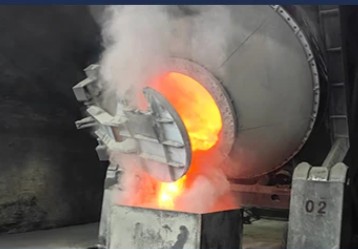
The high-temperature chlorination technology of the rotary furnace is a metallurgical process for efficiently extracting precious metals from slag, especially when processing low-grade and complex slag. The following is a detailed analysis of the rotary furnace's technical principles, core advantages and application value:
I. Technical principles
1. High-temperature chlorination reaction
In the rotary furnace, slag reacts with chlorine (Cl?) or chlorinating agents (such as NaCl, CaCl?) at high temperatures (usually 800~1200℃), and precious metals (Au, Ag, Pt family, etc.) react with chlorine to form volatile chlorides (such as AuCl?, PtCl?), which are then enriched and recovered through condensation or absorption systems.
2. Dynamic reaction environment
The rotary furnace's rotating design allows the material to fully contact the chlorine, enhances mass transfer and heat transfer, and avoids local overheating or uneven reaction.
II. Technical advantages
1. High metal recovery rate:
Precious metal recovery rate > 95%: Volatile chlorides are efficiently captured to reduce residues.
Continuous production: The rotary kiln supports continuous feeding and consumes less energy than intermittent equipment.
2. Wide range of applications:
Applicable to low-grade slag: It can process slag that is difficult to economically recover by traditional cyanidation or pyrolysis (precious metal content as low as ppm level).
Multi-metal synergistic recovery: Synergistic extraction of associated metals such as copper, lead, and zinc to achieve comprehensive resource utilization.
3. Efficient and selective extraction
Fast reaction kinetics: The chlorination reaction rate is significantly improved at high temperature, which is especially suitable for treating refractory precious metals (such as platinum group metals).
High selectivity: By controlling the temperature, chlorine concentration and reaction time, precious metals are preferentially chlorinated rather than gangue minerals to reduce impurity drying
4. Relatively mature process flow:
The high-temperature chlorination technology of the rotary kiln has been studied and applied for many years, and the process flow is relatively mature and stable.
This makes the technology highly reliable and stable in practical applications, and can ensure the smooth progress of the production process.
5. Relatively low energy consumption:
Although the process flow of rotary furnace high temperature chlorination technology is relatively long, compared with other volatilization methods, under the condition of the same heat consumption per ton of ore, this method has relatively low energy consumption.
This is mainly due to the efficient heat conduction and heat utilization capacity of the rotary furnace, as well as the effective recovery of metal chlorides during the chlorination volatilization process.
6. Significant environmental benefits:
Closed-loop system: chlorine gas is recycled, and tail gas is absorbed and treated by alkaline solution (such as NaOH) to avoid Cl? leakage pollution.
Reducing hazardous waste: The toxicity of slag is reduced (such as solidified arsenic and sulfur), which complies with environmental regulations.
In summary, the rotary furnace high temperature chlorination technology has technical advantages such as high metal recovery rate, wide application range, mature process flow, relatively low energy consumption and significant environmental benefits. These advantages make this technology have broad application prospects and important strategic significance in the extraction process from slag to precious metals.