



NEWS&EVENTS
Home > News&Events > Company news > The production process of antimony ingots and Sb?O? after refining in a rotary furnace.
In antimony smelting, the pure molten antimony produced during the refining stage is crucial in determining the final product form. As a manufacturer of rotary refining furnaces, we understand that the design of the post-refining process and equipment selection significantly impact product quality, efficiency, and economic benefits. Below is an analysis of the subsequent processes for two mainstream products: antimony ingots and antimony trioxide powder.
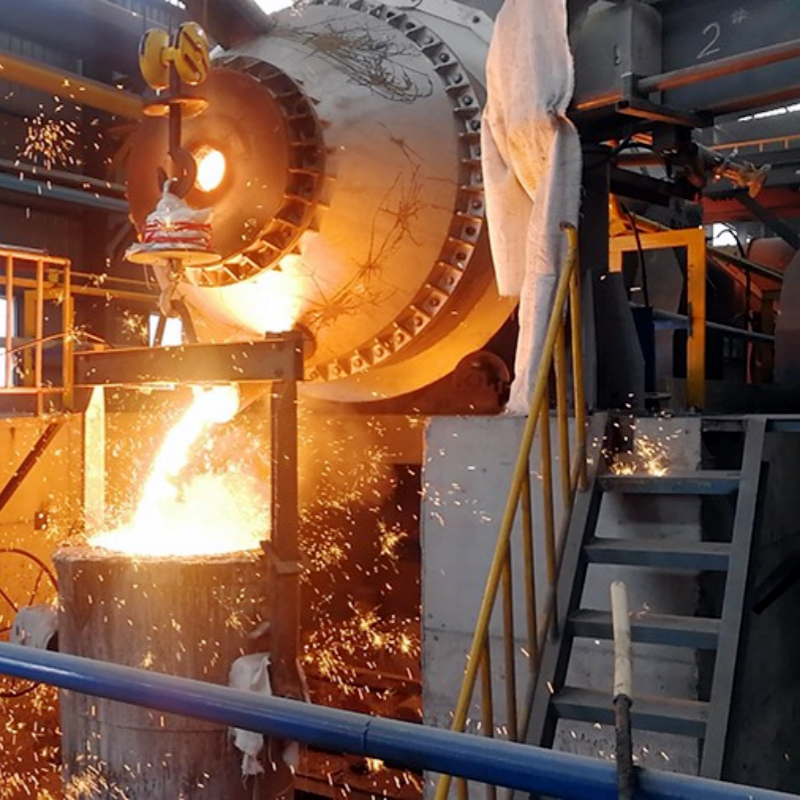
For the production of antimony ingots, the process focuses on efficient and consistent physical shaping. The refined pure molten antimony is fed into a continuous casting machine for continuous casting and cooling. The continuous casting process ensures uniform ingot size and dense structure, improving production efficiency. The formed ingots are then stacked, bundled, and packaged by robotic arms before entering the market. This process is direct and highly automated, suitable for downstream customers with a stable demand for metallic antimony.
For the production of antimony trioxide powder, the process shifts to chemical oxidation and dust collection. The refined molten antimony is transferred to an oxidation furnace, where it is oxidized under specific temperature and atmospheric conditions to produce gaseous antimony trioxide. This gas then enters a dust collection system for cooling and capture, resulting in a fine, uniform powder. This powder is an important flame retardant and chemical raw material, requiring high standards of whiteness, particle size, and chemical purity.
As a rotary refining furnace manufacturer, our equipment plays a core role in both processes. The rotary furnace's uniform heating, excellent sealing, and controllable internal atmosphere ensure product purity and process stability. For the oxidation and powder production process, we can optimize the furnace design to promote the reaction and assist in configuring an efficient dust collection system.