



NEWS&EVENTS
Home > News&Events > Company news > The core function of the electrolytic cell in the copper electrolytic refining process
Electrolytic cells play a crucial role in the copper electrolytic refining process, undertaking several core functions.
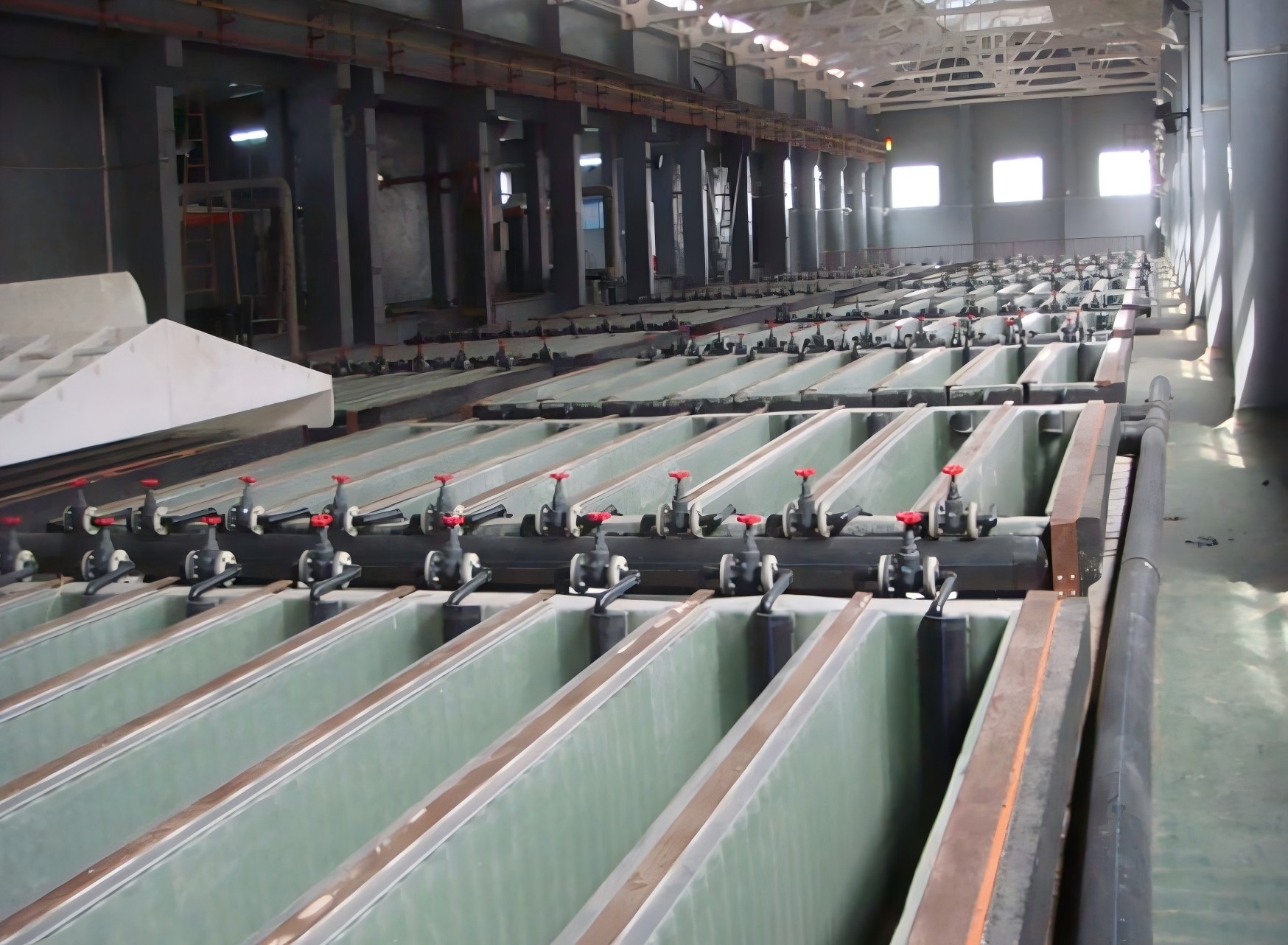
First, it serves a physical support function. In the copper electrolytic refining process, the anode and cathode plates need to be arranged orderly within the copper electrolytic cell, maintaining a precise electrode spacing. An appropriate electrode spacing is crucial for the stability and efficiency of the electrolysis process; too small a spacing may lead to a short circuit, while too large a spacing increases resistance, affecting current distribution and electrolysis efficiency. The copper electrolytic cell, through its specific structural design, provides a stable placement for the anode and cathode plates, ensuring their relative stability during electrolysis and laying the foundation for subsequent electrochemical reactions.
Secondly, as an electrochemical container, the copper electrolytic cell holds the electrolyte. When electricity is applied, the crude copper at the anode undergoes oxidation, with copper atoms losing electrons to become copper ions that dissolve and enter the electrolyte. Meanwhile, a reduction reaction occurs at the cathode, where copper ions in the solution gain electrons and are deposited on the cathode surface, forming high-purity refined copper. The electrolytic cell provides a stable electrochemical reaction environment for this series of dissolution and deposition processes, allowing copper ions to migrate and transform orderly between the anode and cathode, thus achieving copper purification.
In addition, copper electrolytic cells also possess insulation and corrosion-resistant functions. They isolate each electrolysis unit from others, preventing leakage and short circuits between different units, ensuring current flows along a predetermined path, and improving electrolysis efficiency. Simultaneously, since electrolytes are typically corrosive, copper electrolytic cells need excellent corrosion resistance to withstand electrolyte erosion, ensuring their structural integrity and service life, thereby guaranteeing the long-term stable operation of the entire copper electrolytic refining process.