



NEWS&EVENTS
Home > News&Events > Company news > Effects of Rotary Furnace Inclination Angle and Rotation Speed ??on Volatilization Efficiency of Antimony Concentrate
The inclination angle and rotation speed of the rotary kiln are key process parameters that affect the volatilization efficiency of antimony concentrate. The two directly affect the volatilization process of antimony by changing the material movement state, residence time and heat transfer efficiency. The following analysis is carried out from two aspects: theoretical mechanism and practical impact:
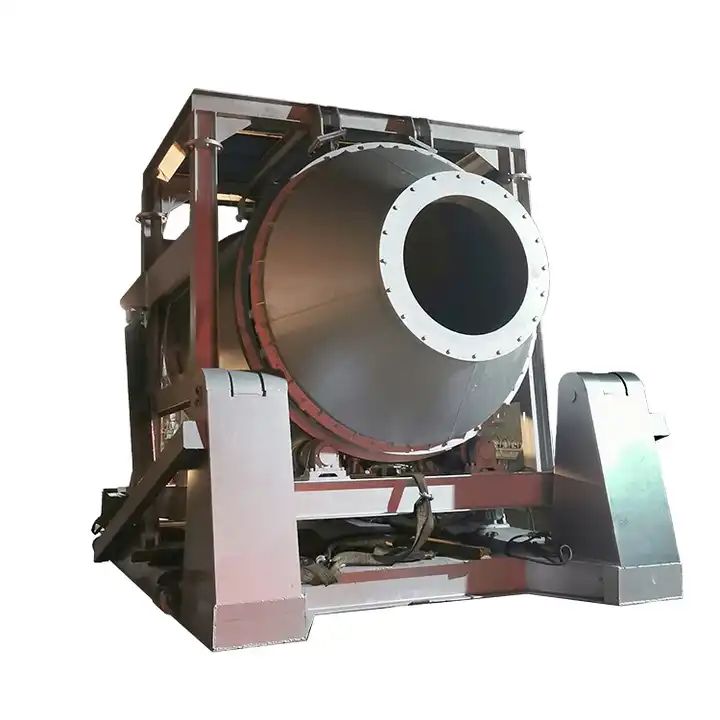
I. The influence of inclination angle on volatilization efficiency
1. Material residence time and distribution
The inclination angle determines the axial movement speed of the material in the furnace. When the inclination angle is too large, the residence time of the material in the furnace is shortened, which may lead to incomplete reaction and reduced volatilization rate; when the inclination angle is too small, the material piles up and causes local overheating or uneven reaction. For example, a smelter adjusted the inclination angle to match the residence time of the material with the time required for the volatilization reaction, and the antimony recovery rate was significantly improved.
2. Heat transfer and reaction efficiency
The appropriate inclination angle can promote the contact between the material and the high-temperature gas, and enhance heat transfer and reaction. For example, in the rotary kiln volatilization roasting, the inclination angle needs to be coordinated with the kiln body speed to ensure that the material is fully exposed to the hot zone to avoid local overheating or underheating.
2. Effect of rotation speed on volatilization efficiency
1. Material mixing and reaction interface
The rotation speed affects the tumbling and mixing degree of the material. When the rotation speed is too low, the material mixing is not sufficient, the reaction interface is small, and the volatilization efficiency is low; when the rotation speed is too high, the material may be over-sprinkled, resulting in insufficient gas-solid contact time. For example, in flash volatilization roasting, the material needs to be finely ground and dried to form a fluidized state, and the rotation speed needs to match the material particle size to ensure efficient reaction.
2. Residence time and volatilization rate
The rotation speed and inclination angle jointly determine the residence time of the material. Too high a rotation speed may shorten the residence time and reduce the volatilization rate; too low a rotation speed may cause material accumulation, prolong the residence time but reduce the processing volume. For example, an experiment shows that the rotation speed and volatilization efficiency are nonlinear and need to be optimized through experiments.
In summary, the influence of the inclination angle and rotation speed of the rotary kiln on the volatilization efficiency of antimony concentrate is multifaceted and complex. In actual production, it is necessary to comprehensively consider the synergistic effect of inclination angle and rotation speed, and find the best combination of process parameters through a large number of experiments and optimization to improve the volatilization efficiency of antimony concentrate and achieve efficient and stable smelting production.