Principle of Slurry Electrolysis of Antimony
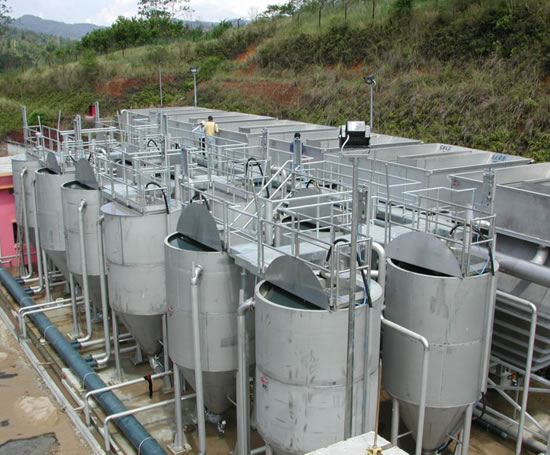
Slurry electrolysis is the process of completing the two processes of hydrometallurgy, leaching and electrolysis, in the same equipment. Under the appropriate electrolyte and electrode system, the antimonide in the antimony-containing slurry is oxidized and dissolved at the anode, enters the solution in the form of ions, and obtains electrons at the cathode to be reduced and precipitate metallic antimony. By controlling the electrode potential and other process conditions, effective separation of antimony and other impurity elements can be achieved.
The use of slurry electrolysis to treat complex antimony ore in a hydrochloric acid-ammonium chloride system is a new hydrometallurgical method. Its novelty lies not only in the use of a new hydrometallurgical technology, slurry electrolysis, but also in the use of a new hydrometallurgical system (hydrochloric acid-ammonium chloride). Through the preliminary determination of the solubility of antimony chloride in the hydrochloric acid-ammonium chloride system under different conditions, it is known that under the experimental conditions (HCl 0.5-1 mol/L, NH4CI 150-200 g/L, 60 degrees), the solubility of antimony chloride can reach more than 100 g/L, which can fully meet the requirements for antimony concentration when plate-like antimony is precipitated at the cathode, and can completely avoid the pollution of antimony caused by the precipitation of lead and other impurities at the cathode, and can well achieve the one-step separation of antimony and lead by slurry electrolysis.
During the electrolysis process of the electrolytic cell, the iron ions act. It is calculated that the potentials of trivalent iron ions and divalent iron ions are much higher than the reduction potential of antimony sulfide, and Fe3+ can completely oxidize Sb2S3. Therefore, the presence of Fe3+ in the solution is conducive to the leaching of Sb2S3. In addition, the equilibrium pH value of the precipitated elemental sulfur (upper limit is -2.34, lower limit is -5.54), when it is greater than -2.34, the sulfur in the sulfide should be oxidized to HS04 or SO42-. In fact, due to kinetic reasons, more than 90% of the sulfur is still produced in the form of a single substance, so it is necessary to maintain a certain acidity of the solution. The addition of hydrochloric acid is conducive to the formation of elemental sulfur, promotes the dissolution of Sb2S3, increases the solubility of antimony in the solution, and prevents the hydrolysis of antimony salts.
For more details, visit our http://m.rebo8.cc/ or contact WhatsApp:+86 18615381239.